Exploring Architecture
American Georgian, 1711-1780
Wells-Thorn House - Main Building
The Street, Deerfield, MA
Built 1747
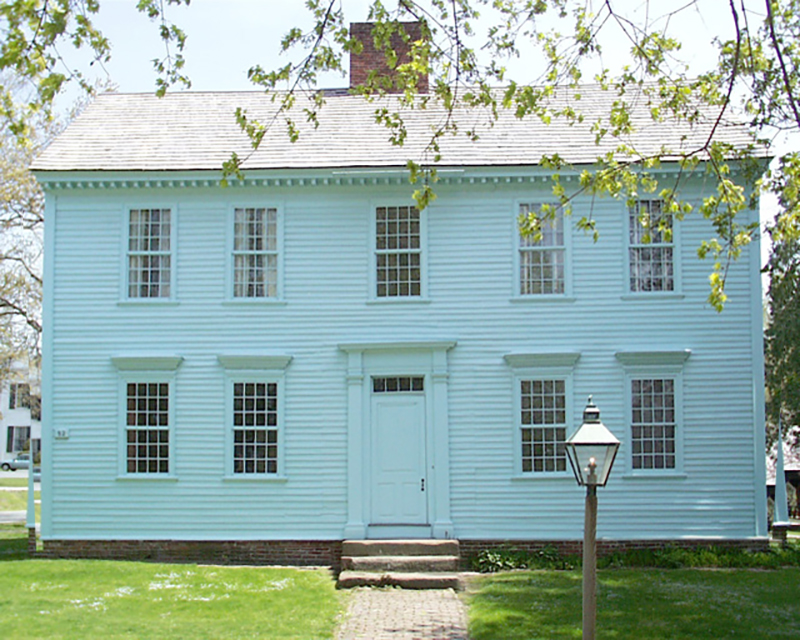
Discover what makes this home Georgian and what decorative elements were taken from Classical architecture.
Chimney
Many Georgian homes (especially those built around the middle of the 18th century) had center chimneys. Constructed with hand-made bricks, the chimney was designed to heat the entire home and provide it with a cooking hearth. It opened into fireplaces in each room. Each fireplace had an individual flue which traveled up the chimneystack and vented out the top.
Roof
In northern colonies, such as Massachusetts Bay, the roofs on Georgian homes could be gambrel, hipped, or, like the Wells-Thorn House, pitched (also called side-gabled). Unlike the 17th century style roof, Georgian roofs were not as steeply pitched, due in part to the addition of ridge poles. Under the cornice are modillions, another decorative element common in the Georgian style.
Windows
There are many more windows on this Georgian Style portion of the Wells-Thorn House than on the Post Medieval part. The Georgian Style includes large, double-hung sash, windows, with twelve lights above and twelve below. The designer located them with an eye toward balance and symmetry, not to where the rooms inside needed light. In fact, this type of window arrangement brought with it new problems; too much light could quickly fade fabrics and sun-bleach furniture. The windows on the Wells-Thorn house are topped with window caps that are decorated with dentils.
Painted Clapboard
In the Northern colonies, Georgian homes were most often covered with narrow clapboards. These are long, thin boards (often pine) attached onto the framing of a house. Just like a bird’s feathers they overlap, creating a barrier that protects the house from the elements like rain, snow, cold and wind. The clapboards on the Wells-Thorn House were painted, an expensive luxury during the 1700s.
Door
In the Georgian style, the door and its surround takes center-stage, playing a large part in the building’s overall design. It is often paneled, creating the illusion of stone, with transom lights above. In the Wells-Thorn House, the existing front door (though probably not the first on this building) also has elements from ancient Greece and Rome, translated into modern architecture by Italian and English architects. Decorative pilasters frame each side of the door. A simplified entablature rests above the pilasters.
The Wells-Thorn House
The Wells-Thorn House is a big building that has been around for
a very long time. The main building, was built in 1747.
Every house has bits and pieces that place it within a time, a place and an architectural style. This building was constructed in the Georgian Style, a type of early American architecture influenced by the classical orders of ancient Greece and Rome, the designs of Italian architect Andrea Palladio, and English architects like Inigo Jones and Sir Christopher Wren.
The Georgian Style came to America during the early 1700s, influencing house building throughout the English colonies. As people realized they were here to stay and their settlements were becoming towns and cities, homes became more than just safe havens. Unlike the small, boxy houses of the earlier Post Medieval Style, Georgian homes were larger, often a full two stories high and one room deep. Design, not need, decided where windows and doors were placed. What makes the Wells-Thorn House Georgian?
Like other Georgian buildings, the Wells-Thorn house is completely symmetrical, inside and out. On the inside, it is organized using a hall and parlor plan, with two rooms on the first floor and two rooms above. In the 18th century, Georgian homes were planned according to a complex system of balance and proportion. During the design stage, the façade of a Georgian home is divided into small parts and bays . All of the parts and bays work together to all create a balanced design.
The outside of the Wells-Thorn House contains something else that is new to American architecture; decoration. It appears around the door, over the windows, and even under the eaves. The Georgian Style included many architectural elements, like pediments, pilasters and dentils, which are inspired by the designs of classical Greece and Rome.
History
Ebenezer
and his wife, Abigail Barnard Wells, lived in this home with
their two slaves, Lucy and Cesar. The Wells had no children.
Ebenezer Wells died in 1758, leaving the house to his newly married 28-year-old nephew, also named Ebenezer. His widow Abigail moved to Northampton. Nephew Ebenezer and his wife Mercy (Bardwell) had nine children, eight of whom lived to adulthood. The house was revised, updated, and rearranged, in order to accommodate the growing family. When nephew Ebenezer died in 1783, an extensive inventory of his possessions was compiled.
Nephew Ebenezer left the Wells-Thorn House to his wife, Mercy. Their son Ebenezer and his wife Anna (Saxton) joined her in the house. Son Ebenezer was a silversmith by trade and, like his grandfather, operated a tavern in the home. Mercy actually outlived her son Ebenezer, who died in 1793. In 1795, Mercy transferred ownership of the entire house to another son David. Mercy continued to live there until she died in 1801.
David Wells did not live in the Wells-Thorn House with his mother, having his own home just next door. Shortly after receiving it, David sold the house to Hezekiah Wright Strong, a lawyer from Amherst. Hezekiah only lived and worked in the Well-Thorn House for three years, selling it in 1804 to blacksmith John Dwight. In 1808, Dwight sold the portion of the property not used for his trade, to Orlando Ware, a storekeeper and prominent man-about-town in Deerfield. The house remained in the Ware family until 1905.
In 1905 Luanna Thorn purchased the house from the Ware family. Her husband Edwin was a doctor, an antiquarian, collector and cabinetmaker, who became very involved in Deerfield life. In 1962 Historic Deerfield, Inc purchased the Wells-Thorn House. It has been fully restored and is open to the public as a Museum.
Floor Plan
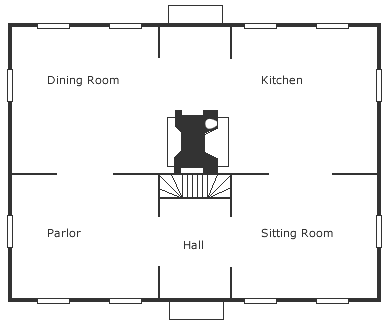
Many Georgian homes were laid out according to a symmetrical Hall and Parlor Plan. This plan featured a center chimney with rooms of equal size on either side. In front of the chimney was an inner entryway called a porch and a stairway leading up to the garret. To the right of the chimney was the parlor. Up the stairs were two more rooms, called chambers, which were used mostly for sleeping.
Interior
 |
|
 |
|
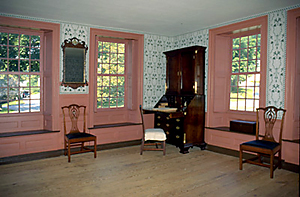
North Parlor, Northwest Corner
Courtesy of Historic Deerfield, Inc., photography by Amanda Merullo
|
|
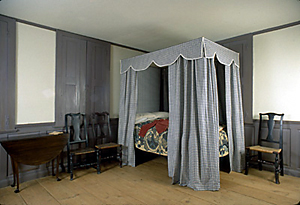
South Parlor, Southwest Corner
Courtesy of Historic Deerfield, Inc., photography by Amanda Merullo
|
Glossary of Architectural Terms | Architectural Resources
top of page
|





